Subject and Composition
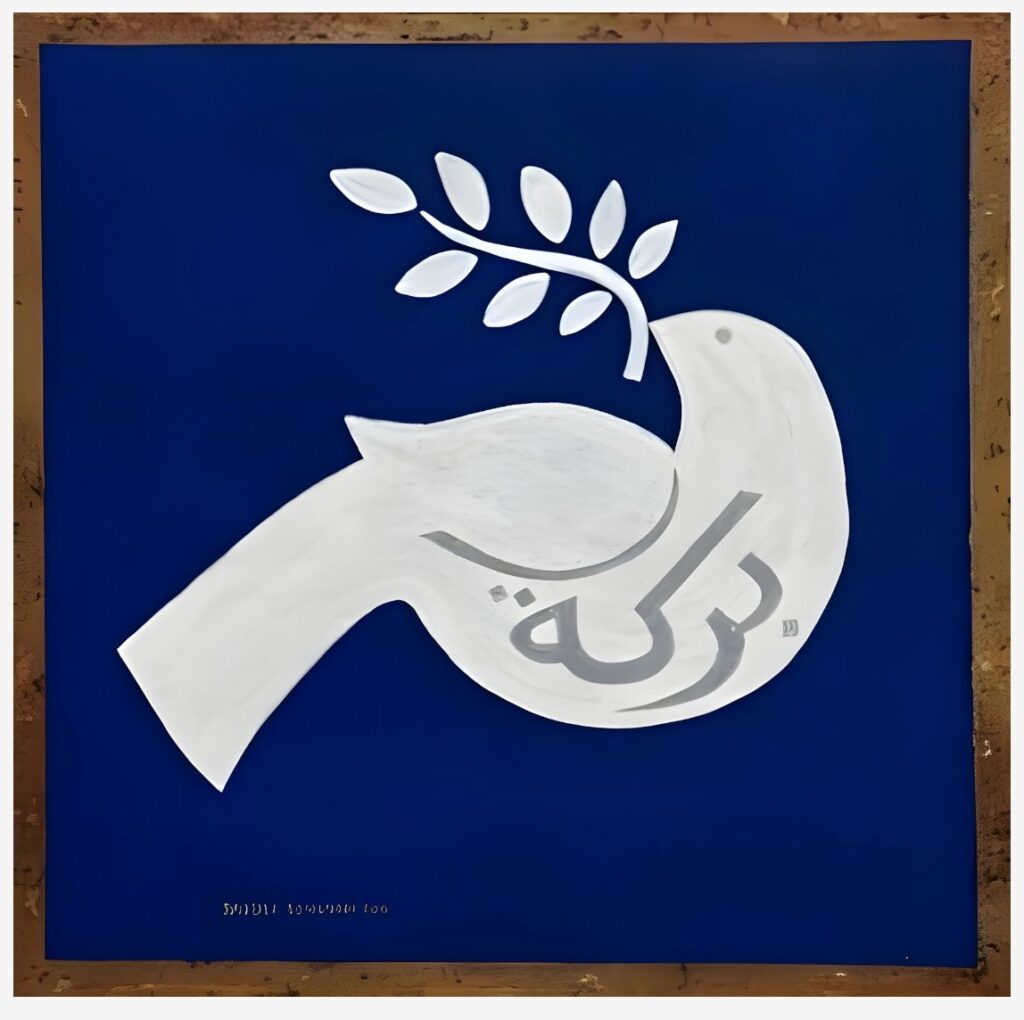
A dove, rendered in flat white against a field of deep cobalt blue, carries an olive branch in its beak, its leaves spread like fingers reaching outward. Across the body of the bird, almost hidden within its own whiteness, the word baraka is written in soft grey Arabic script. Blessing, written onto the body of the thing that carries peace.
The composition is reduced to its essential elements: one bird, one branch, one word, one field of colour. Nothing competes for attention. The eye moves from the dove’s beak along the curve of the olive branch, then settles on the script at the centre of the bird’s body, the place where image and word meet.
Line, Form, and Technique
Sehnaoui’s dove is not naturalistic. It is iconographic, closer to a seal or an emblem than a study of a bird, built from sure, graceful lines without ambiguity. The wing is a single curved form, the body a clean white shape against the blue. Critics of her wider body of work have noted this same quality across her career: an artist trained as both designer and painter, rendering images with the precision of one and the soul of the other.
The edges of the dove are crisp, almost stencilled, and the calligraphy carries the same controlled clarity as the bird’s outline. This is not naive simplicity. It is the deliberate economy of someone who understands exactly how much can be removed before an image stops working.
Tone and Colour
The cobalt blue is total. It gives the white dove nowhere to hide and nothing to compete with. This is a colour choice rooted in the same visual language Sehnaoui has drawn from throughout her career, flat planes of saturated colour found in Byzantine icons and Persian miniatures, traditions where colour itself carries meaning rather than simply describing the world.
The blue here is not sky. It is depth, almost devotional in its intensity, the kind of blue found in old manuscripts and mosaic tile, against which the white dove appears less like a creature in flight and more like something revealed.
Material and Symbolism
A gold border frames the entire composition. Gold has long signified sanctity in devotional art, and its presence here lifts the painting beyond a graphic symbol into something closer to an icon, asking to be looked at with quiet attention rather than analysed for detail.
Baraka means blessing. Writing it in grey upon white, nearly the same tone as the dove itself, was not an act of concealment but of fusion. The blessing is not separate from the bird. It is woven into its body, inseparable from what the dove already represents. The pairing of Arabic script with Byzantine colour and Phoenician simplicity reflects a cultural inheritance that Lebanon has always held at once, layered, plural, and never reducible to a single tradition.
The Light It Carries
Sehnaoui has spent a lifetime painting Beirut and Lebanon with a loving, nostalgic eye, not as something lost, but as an insistent reality she believes will live on. She has said, of her own work, that life goes on, even during the worst of wars.
Baraka speaks directly to that conviction, and to Lebanon itself. A country that has absorbed war, displacement, and loss repeatedly, and has just as repeatedly returned to its own image of peace, its own olive branch, its own blessing, without ever fully letting go of either. The dove does not pretend the conflict away. It simply insists that blessing has survived it, again and again, and continues to belong to the people who have lived through it. What this painting offers, for generations of Lebanese people to come, is permission to hold onto hope without softening the truth of what came before it.
Baraka is not granted from outside. It is what survives inside us, quietly, no matter what comes.